Revisiting the Marjory Fleming Project
Updated: Aug 21
For a new blog, I wanted to rehash some old work and look back at my time at the National Library of Scotland (NLS). This post revisits work to create the Library's first dataset using AI-enabled Handwritten Text Recognition (HTR). Working with the Digital Scholarship Team, we created an accurate transcription of the 19th century diaries written by Scottish child author Marjory Fleming (1803-1811), published online in 2021.

Frontage of the first Fleming volume (1810)
The diaries were selected as an important historical resource, with few sources centring children as authentic voices of their own experiences. Presented to the Library in 1930, Marjory Fleming's writing forms a rare exception and rich resource for children's history. Their pages are filled with witticisms, moralisms, and copybook notes, all completed under the watchful gaze of Fleming’s tutor and older cousin Isabella Keith. That said, the diaries are not entirely humourous, also including deep personal tragedy. The collection ends with a few pages written not in Fleming’s hand but those of her cousin and her mother. They express deep grief in Marjory’s untimely death in December, 1811, aged 8, from measles and meningitis. In their words, Marjory was left powerless to act against '… so heavenly mercy’s plan'.
It was essential, therefore, for the Library to fully incorporate such intimate and meaningful records into their digitisation workflows and provide accurate transcriptions of such works. In taking scanned images from the NLS digital gallery, the HTR platform Transkribus was used to automatically convert these images into computer-readable text. For a deeper explanation of the process, see the NLS blog post for the project: https://blog.nls.uk/automatically-transcribing-the-marjorie-fleming-diaries/. Without the kind of 'Collections as Data' (Padilla, 2019; Candela, 2024) guidance now readily accessible through organisations such as LIBER (European Association of Research Libraries), we would have been lacking expertise.

Transkribus downloaded client, showing metadata and training data of the Fleming model, entitled 'Early 19th Century (Child)
With these resources, as well as Transkribus' own guides, we recorded an eventual CER (character error rate) of 1.85%. These transcriptions only required minimal correction and
formed the base for the various file outputs now available to researchers via the NLS's Data Foundry, a dynamic destination where data is stored, welded together, replayed and reused: https://data.nls.uk/data/digitised-collections/marjory-fleming/
This work was also well received, which is always heartening.
We made up some column inches in the Fife press and Scotsman and, more recently, William Kilbride included the transcriptions as a case study in his 2024 keynote on Artificial Intelligence and Digital Preservation to IFLA (International Federation of Library Associations). The READ-COOP, who maintain and develop Transkribus, also included the images and transcriptions from the Fleming diaries as part of their new web app launch, earlier this year.
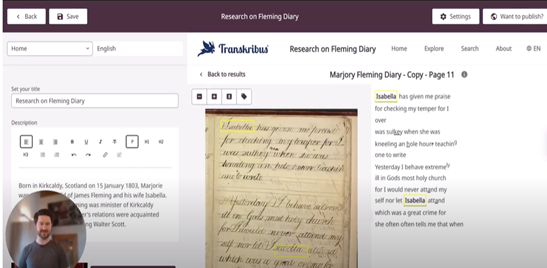
Transkribus launch of their web publishing tool, Transkribus Sites, using the Fleming diaries, with the always energetic and engaging Matthias Sorg
Personally, this experience transcribing Fleming's diaries deepened my thinking surrounding the different histories we can tell when given free-flowing access to personal archives, where appropriate. These archives, unlike many printed business - organisational archives are not created with an intended audience in mind. They are also often situated closer to events (Simpson, 2020). For historians, they present the
pinnacle of source material when attempting to reflect accurate retellings of the past.
How do these histories emerge when digital technologies are leveraged to make materials further available? Can they tell us more than our printed - regimented - standardised - industrialised - mechanical documents can? If so, how?
Now, with the NLS becoming more involved with Transkribus against the backdrop of proactively constructing AI ethics guidelines and promoting greater automation internally, this project forms one small step for the Library. AI in archives certainly suffers from a hype curve. NLS staff are increasingly aware of this - dealing with more and more user requests for transcriptions, AI outputs or general advice. However, such technology has clear value, when properly directed, in generating data and even in preserving it (Kilbride, 2024). As with the Fleming diaries, AI can provide access to authentic and overlooked voices. As Kilbride says:
'There are so many voices from so many digitization projects that are just waiting to be heard.'
***
Thank you to Dr Sarah Ames, Digital Scholarship Librarian, for supporting this placement project.
References
Candela, G. (2024) ‘Collections as Data: Getting Started’, Digital Scholarship & Data Science Essentials for Library Professionals. https://libereurope.github.io/dsessentials/collectionsasdata.html
Crow, A. (2021) 'AI transcribes historical diaries of child prodigy pet marjorie', Fife Today, February 4, https://www.fifetoday.co.uk/news/people/artificial-intelligence-transcribes-historic-diaries-of-child-prodigy-pet-marjorie-3124330
Kilbride, W. (2024) 'DP and Artificial Intelligence - A Four Point Plan', Digital Preservation Coalition, https://www.dpconline.org/blog/dp-and-artificial-intelligence-a-4-point-plan
Padilla, T., Allen, L., Frost, H., Potvin, S., Russey Roke, E., Varner, S. (2019) Final Report - Always Already Computational: Collections as Data. doi: https://zenodo.org/record/3152935#.X6WOf-LPzIU
Simpson, K. (2020) ‘The digital archive as space and place in the constitution, production and circulation of knowledge’, in Ben Fletcher-Watson and Jana Phillips (eds.), Humanities of the Future: Perspectives from the Past and Present, vol. 22, pp. 65-82. Edinburgh, IASH Occasional Papers.
Transkribus. (2024) Publish Documents with Transkribus Sites, https://www.youtube.com/watch?v=LlApHRWN6Uo
For further reference -
Transkribus. (2024) https://www.transkribus.org/


Comments